

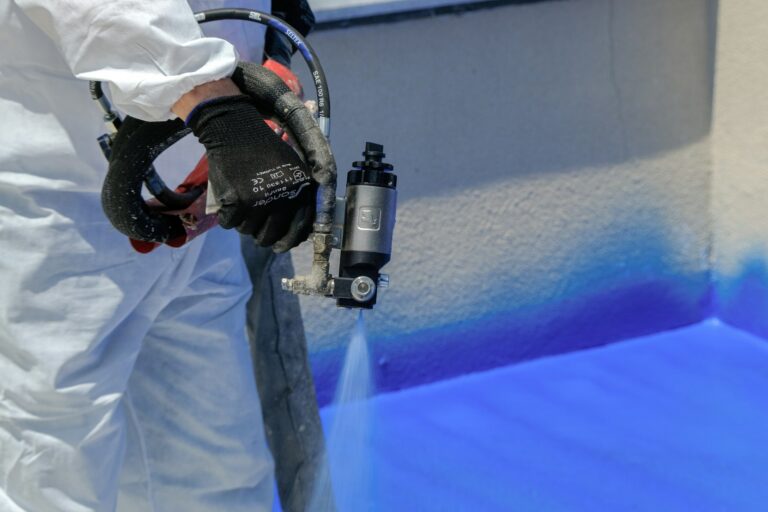
The structure is engineered, the panels are specified, and the schedule is locked. Then the insulation question lands: what actually works inside a cold-formed steel building in Texas heat, and where do the rules shift from what you know about wood?
Spray foam insulation for steel buildings is a different call than it is in a wood-framed wall. Steel conducts heat at roughly 300 times the rate of wood, so every stud flange becomes a direct thermal bridge from inside to out. That single fact reshapes your foam choice, your vapor strategy, and where the dew point lands in the assembly.
This walks through how open-cell and closed-cell foam behave against steel, what condensation risk looks like at the flange, and how panelized fabrication changes insulation sequencing. It is written for builders and developers in Texas and the south-central US, where summer heat and swings in humidity push the vapor math harder than milder climates do.
Why Steel Framing Changes the Insulation Math
Insulating steel is not the same as insulating wood with a different stud. The metal moves heat so well that the framing itself becomes the weak point in the wall, and the assembly has to answer for it.
The Steel Flange as a Thermal Bridge
A steel stud is a highway for heat. Where a wood stud slows conduction, a steel flange carries it straight through the cavity insulation, shorting out part of the R-value you paid for. The effect is not small: cavity insulation between steel studs can lose a large share of its rated performance once the flanges are in the path.
That is why rating a steel wall by its cavity foam alone overstates it. The number that matters is the whole-assembly U-factor, which accounts for the flanges. The thermal design guide for cold-formed steel walls publishes U-factor tables that show how far cavity-only assemblies fall short.
Condensation Risk at the Cold Flange
Thermal bridging does more than waste energy. In a Texas summer, a flange chilled by interior air conditioning sits below the dew point of the humid outdoor air pushing into the wall. Warm, wet air reaching that cold steel condenses on it.
Steel will not rot the way wood does, but standing condensation still corrodes fasteners, wets adjacent finishes, and feeds mold on paper-faced materials. Controlling where the dew point lands is the core of insulating steel correctly, and it drives the choice between open-cell and closed-cell foam.
Open-Cell vs Closed-Cell Spray Foam in Steel Assemblies
The two foams are not interchangeable in a metal building. Density, R-value, and permeability separate them, and on steel those differences decide whether the flange stays dry.
Closed-Cell: R-Value, Vapor Control, and the Flange
Closed-cell spray foam runs about R-7 per inch and reaches Class II vapor-retarder territory at roughly 1.5 inches. Sprayed against the steel, it does two jobs at once: it insulates and it keeps humid air off the flange, which is exactly the condensation problem steel creates.
Its higher cost per board foot is real, but on a steel assembly it buys air sealing, moisture control, and rigidity in one application. For most conditioned steel buildings in a hot, humid zone, closed-cell spray foam for steel framing is the safer default at the flange.
Open-Cell: Where It Fits and Where It Does Not
Open-cell foam is lighter, cheaper, and runs about R-3.8 per inch. It fills and air-seals a cavity well, but it is vapor-open, so it does not stop humid air from reaching a cold steel flange on its own.
Used on steel in a humid climate, open-cell foam usually needs a separate vapor-control layer to keep the dew point out of the steel. It has a place on interior partitions and in sequencing where vapor drive is not a concern, but it is not a standalone answer on an exterior steel wall.
| Property | Closed-Cell | Open-Cell |
|---|---|---|
| R-value per inch | About R-7 | About R-3.8 |
| Vapor control | Class II retarder near 1.5 in | Vapor-open, needs separate retarder |
| Air barrier | Yes | Yes |
| Adds rigidity | Yes | No |
| Best fit on steel | Exterior walls, flange condensation control | Interior partitions, sound, budget cavities |
Continuous Insulation That Actually Beats Thermal Bridging
Cavity foam alone, of either type, still leaves the flanges bridging heat. Breaking the bridge takes insulation that runs unbroken across the studs.
Why Cavity Foam Alone Falls Short on Steel
Spray foam in the stud bays insulates the bays, not the steel crossing them. The flanges still connect inside to outside at every stud, so the wall underperforms its cavity R-value no matter how well the foam is applied.
The fix is a layer of insulation on the exterior face that no stud penetrates, called continuous insulation (CI). A CI layer covers the flanges, lifts the whole-wall U-factor, and moves the framing toward the warm side of the dew point.
Pairing Spray Foam With Exterior Continuous Insulation
The strongest steel-wall assemblies pair a cavity fill for sound and space with exterior CI for the thermal break. Energy codes increasingly require it: newer IECC and ASHRAE 90.1 editions call for one to four inches of exterior CI on steel-framed walls by climate zone.
Rigid foam sheathing at the exterior does the bridging work while closed-cell in the cavity handles air and vapor at the flange. The continuous insulation requirements for cold-formed steel walls lay out how much CI a given zone needs.
- Confirm the climate zone and the CI thickness the energy code sets for it
- Choose cavity foam for air and vapor control at the flange
- Size exterior CI to cover the flanges and hit the assembly U-factor
- Detail the CI layer to stay continuous at openings, corners, and slab edges
Air Sealing and Dew Point Control in Texas Humidity
R-value is only half the wall. In a climate that pushes humid air at a cooled building, controlling air and moisture movement decides whether the assembly lasts.
Hitting the Air Barrier at the Assembly
Uncontrolled air leakage carries far more moisture into a wall than vapor diffusion does. Both spray foams air-seal when applied to full thickness, which is a real advantage over batt insulation that leaves gaps around every stud and penetration.
Detailing matters as much as the foam. Seal the transitions the spray gun cannot reach on its own: top and bottom track, panel joints, window and door rough openings, and service penetrations. A continuous air barrier only works if it is actually continuous.
Keeping the Dew Point Out of the Steel
The goal is simple to state: keep the steel warmer than the dew point of the air that can reach it. Closed-cell foam against the flange plus exterior CI does this by both sealing humid air out and shifting the framing to the warm side.
Get the layering backward, or leave the flange vapor-open in a humid zone, and moisture collects on the coldest surface in the wall, which is the steel. Set the vapor and air strategy at design, not after the foam truck arrives.
How Panelized Steel Changes Insulation Sequencing
Off-site fabrication does not change the building science, but it does change when and how insulation goes in. That timing affects both quality and schedule.
Panelized steel walls arrive with studs, track, and openings already set to the engineered drawing, so the insulation crew works from a fixed, consistent cavity depth on every panel. Spray foam hits target thickness without chasing the warped bays that stick-built lumber produces. Some assemblies can even be foamed or fitted with CI in the shop, under controlled conditions, before panels ship.
Decide the sequence early: shop-applied versus field-applied foam, and where the air and vapor layers land relative to fabrication. Because the framing dimensions are locked before delivery, the insulation plan can be locked with them instead of improvised at the wall.
Insulate the Assembly the Framing Made Possible
Spray foam in a steel building behaves differently than it does in wood, and the difference traces back to the framing. Consistent steel dimensions give the insulation crew a fixed cavity, predictable flange locations for the thermal break, and clean openings that keep sequencing tidy.
The framing package sets the baseline for every layer that follows: foam type, air and vapor control, and how the wall performs for the life of the building. Choosing the right steel framing before you spec insulation is what keeps the whole assembly working as designed.
If you are pricing a project in Texas or the south-central US, start with the structure the insulation is built around. Reach Symmtrex for an engineered steel framing system or call (469) 842-7794 for a fabrication estimate.
Frequently Asked Questions
Should You Use Open-Cell or Closed-Cell Spray Foam in a Steel Building?
On exterior steel walls in a hot, humid climate, closed-cell is the safer default. It delivers about R-7 per inch and acts as a vapor retarder near 1.5 inches, which keeps humid air off the cold flange. Open-cell fits interior partitions or budget cavities where vapor drive is not a concern.
Does Spray Foam Stop Thermal Bridging Through Steel Studs?
Not on its own. Foam in the stud bays insulates the bays, but the steel flanges still bridge heat across them. Breaking the bridge takes exterior continuous insulation that runs unbroken across the studs, paired with cavity foam for air and vapor control.
Will Condensation Form on Steel Studs Behind Spray Foam in Texas?
It can, if the flange stays colder than the dew point of the air reaching it. Closed-cell foam against the steel plus exterior continuous insulation keeps humid air out and moves the framing to the warm side, which is what prevents condensation on the metal.
How Much Closed-Cell Spray Foam Controls Vapor on a Steel Wall?
Closed-cell foam reaches Class II vapor-retarder performance at roughly 1.5 inches, though the exact thickness depends on the assembly and climate zone. Confirm the required thickness against the wall design rather than assuming a single number covers every condition.
Do You Still Need Exterior Continuous Insulation if You Foam the Cavity?
Usually yes on steel. Cavity foam alone leaves the flanges bridging heat, and current energy codes call for one to four inches of exterior continuous insulation on steel-framed walls by climate zone. The cavity foam and the continuous layer do different jobs in the same wall.
Get a fabrication estimate from a North Texas manufacturer with a 500-mile delivery range.